Dorrigo Evans—Tenji Nakamura
The Narrow Road to the Deep NorthDorrigo Evans and Tenji Nakamura are opposing commanders in the Siamese POW camp whose relationship moves between practical negotiation and moral confrontation. Their exchanges make the railway’s violence intimate: Dorrigo tries to protect individual prisoners, while Nakamura can acknowledge suffering yet continues to enforce the system that produces it. Neither man remains outside that system. Dorrigo’s efforts sometimes help prisoners, but they also leave him implicated in choices made under Nakamura’s orders; Nakamura’s occasional concessions do not interrupt the railway’s demands.
Commanders in an Unequal Negotiation
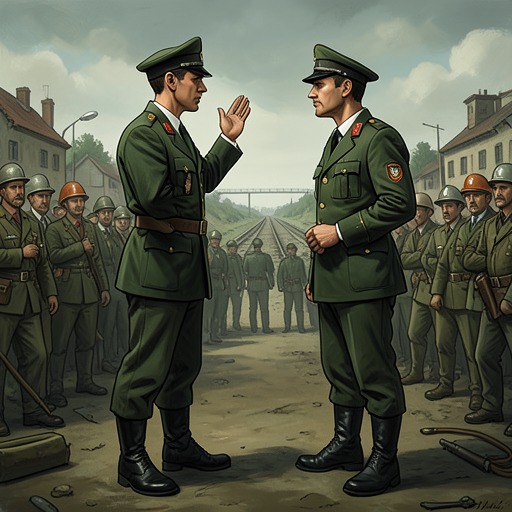
The relationship begins from a position of unequal power. Dorrigo is the Australians’ commanding officer, responsible for men confined and made to work by the Japanese military. Nakamura commands the camp and can order punishment or demand more labour. Their dealings are not simply personal antagonism: they are negotiations conducted within an occupation in which Nakamura has authority and Dorrigo’s leverage is limited to argument, bargaining, and the possibility of protecting prisoners by making choices for them.
The novel presents an earlier contrast between their pragmatic dealings and the violence that follows. Dorrigo has played cards with Nakamura the night before the punishment, and that morning the men have bartered over lives. The familiarity of a card game and the practical language of bargaining do not amount to trust or equality. They make the later confrontation more disturbing: the officer Dorrigo had encountered as a strange but human man becomes, in his perception, an instrument of a force that bends people and nations to its purposes.
The Punishment of Darky Gardiner
The defining confrontation occurs when the Goanna and other guards beat the sick Darky Gardiner. Dorrigo runs toward the prisoners despite his ulcerated ankle, calling out in Japanese that he is sick. Once Nakamura arrives with Lieutenant Fukuhara, Dorrigo steps out of line and pleads for the punishment to stop. He tells the officers, “This man is severely ill. He needs rest and medicine, not a beating.” Nakamura acknowledges Dorrigo’s superior rank with a slight bow, but Dorrigo does not return it. The formal gestures register the authority contest even as the beating continues behind them.
Nakamura initially appears to act when Dorrigo argues that the guard has ignored a colonel and commanding officer. After Nakamura trips in the mud, he sees that the fall has been witnessed by prisoners, Korean guards, and Japanese officers. He then takes a pick handle from the dumped tools, strikes the Goanna across the kidney and neck, and hits him on the head. Nakamura returns to Dorrigo and bows; this time Dorrigo bows back without intending to. The moment briefly reverses the camp’s hierarchy: the Japanese major punishes a guard for insulting the Australian colonel. But the reversal is not a reprieve for Darky. Nakamura explains that the guard has been punished for his insolence and that the prisoner’s punishment can continue. The Goanna resumes the beating with renewed force.
That distinction defines the limits of Dorrigo’s influence. Nakamura can use the incident to address an affront to an officer’s authority, but he does not use his power to protect the sick prisoner. Dorrigo protests again, calling the beating wrong and insisting that Darky is very ill. Nakamura speaks in a kinder voice and offers extra quinine for sick men so they can work. The offer acknowledges illness only insofar as treatment may return prisoners to labour. The railway remains the measure against which both compassion and discipline are judged.
Recognition, Complicity, and the Railway
Watching Darky repeatedly beaten, Dorrigo understands that Nakamura believes the punishment necessary for the railway to be built. He is appalled by the violence, yet he also recognizes in Nakamura a terrible will and an obedience to codes that allow no doubt. The recognition does not excuse Nakamura. Instead, it unsettles Dorrigo’s earlier sense that his adversary can be understood chiefly as a harsh but pragmatic commander. Nakamura now appears to him as a force through which war distorts individual judgment and carries destruction beyond the intentions of any one person.
Nakamura’s offer of quinine sharpens that contradiction. Dorrigo understands that Nakamura is trying to help some sick prisoners, but also that he cannot or will not stop the beating he ordered. The medicine may assist men who are expected to keep working; it cannot save Darky from the punishment underway. Dorrigo consequently sees the two officers, and the prisoner, as caught in different parts of the same violent enterprise. Nakamura orders and administers punishment, Dorrigo has a part in the railway despite his resistance, and Darky is made to suffer for it. Their positions are not morally equivalent, but neither can Dorrigo turn his protest into an escape from implication.
The scene also changes Dorrigo’s understanding of his own command. Three hundred men watch three guards destroy a man they know, and Dorrigo recognizes that he is among those who watch and do nothing. He had arrived too late and done too little; now, in some sense, he has assented to what is happening. That recognition gives the encounter its lasting force. Dorrigo’s failure is not that he secretly approves of the beating, but that his position and choices cannot make him an effective barrier against it. Nakamura’s authority enforces the punishment; Dorrigo’s rank and appeals cannot stop it.
The Forced March and Dorrigo’s Choice
A later order from Nakamura renews the relationship’s central conflict in a different form. Near midnight, after waking from a dream of death, Dorrigo addresses the seven hundred men assembled for a count. Nakamura has ordered that one hundred prisoners be selected to march one hundred miles through the jungle to a camp near Three Pagoda Pass. Dorrigo argues that none of them is fit for another march and warns that the prisoners will all die unless their treatment changes. Nakamura insists that the hundred must be found and says that he will choose them himself if Dorrigo refuses.
Nakamura’s response makes the practical stakes brutally clear: the march will save the Japanese army rice. Dorrigo understands that if Nakamura makes the selection, it will be indiscriminate and may include the sickest men, who are least useful to him. If Dorrigo chooses, he can select the fittest, giving more of them a chance to survive, although he expects most to die anyway. The decision is therefore not a straightforward act of consent or defiance. To refuse is to leave the choice to Nakamura; to comply is to serve the agent of death by choosing which prisoners will be exposed to it.
The earlier plea for Darky and the later selection order expose the narrowness of Dorrigo’s power. In both episodes, Nakamura determines what the railway requires, while Dorrigo is forced to decide what can still be done for the prisoners within those terms. His choices may lessen the harm for some without stopping the system or making the outcome just. Their relationship is thus defined not by reconciliation but by an unequal, recurring negotiation in which Dorrigo’s responsibility deepens even as his ability to protect his men remains constrained.